A tagline that works in English can land as an insult in Spanish or Tagalog. It usually happens because no one wrote a cultural review step into the approval process during the first week of the partnership. Mistakes like that rarely start at launch. They start in onboarding, the first 30 to 90 days when a brand and its multicultural marketing agency settle who they’re speaking to, what they’ll say and how they’ll measure it.
Brands that get this stretch right end up with campaigns that feel authentic to the people they’re meant for. Brands that rush it often watch strong creative reads like an afterthought someone translated at the last minute.
The top multicultural marketing agencies treat onboarding as real work, and they expect the brands they partner with to arrive prepared. Talk to The Sax Agency, a minority owned multicultural marketing agency in Los Angeles, and the first conversations cover far more than logos and logins. Expect cultural strategy, public relations, social media, urban and event marketing, and influencer relationships that reach across many communities.
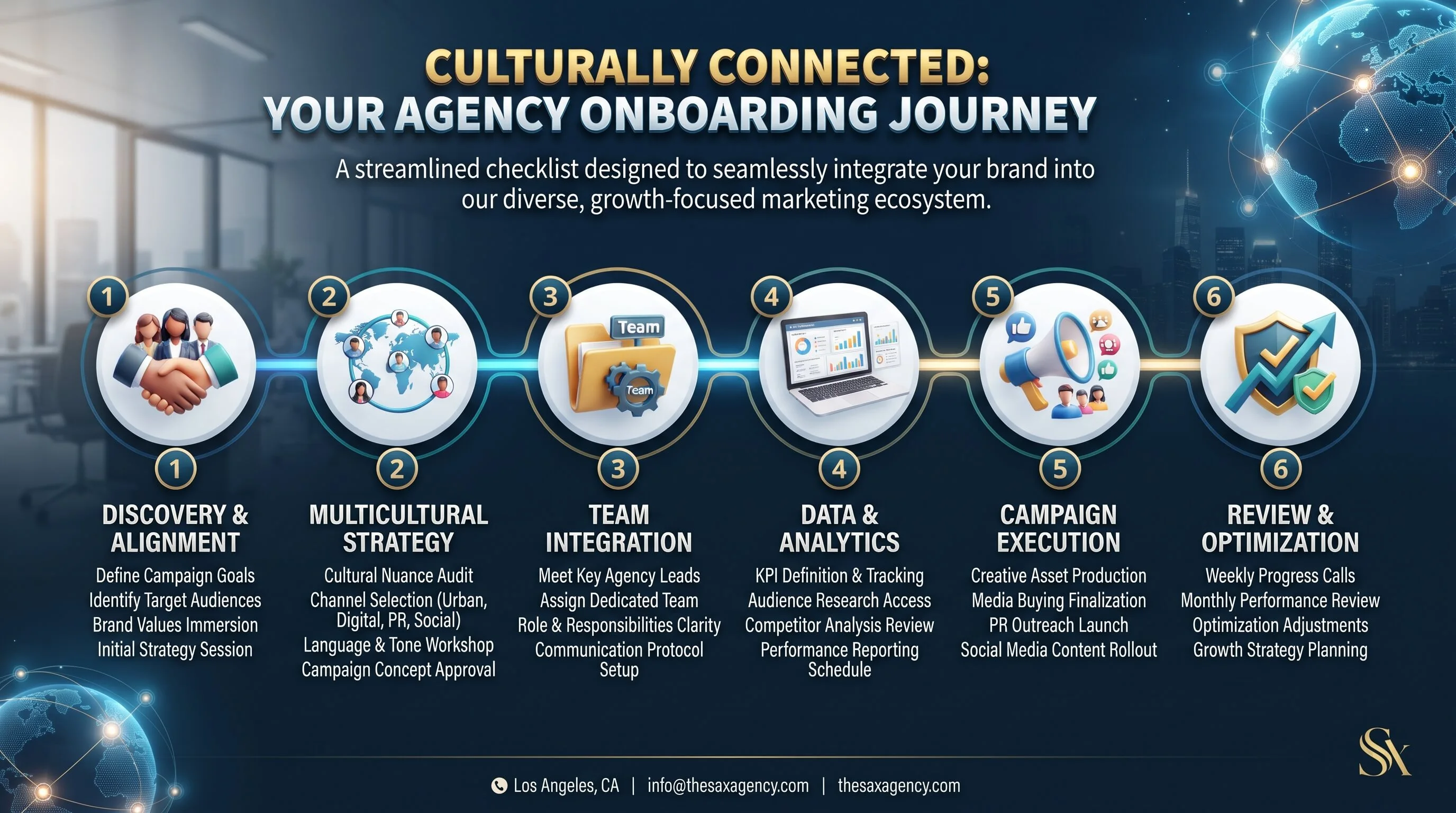
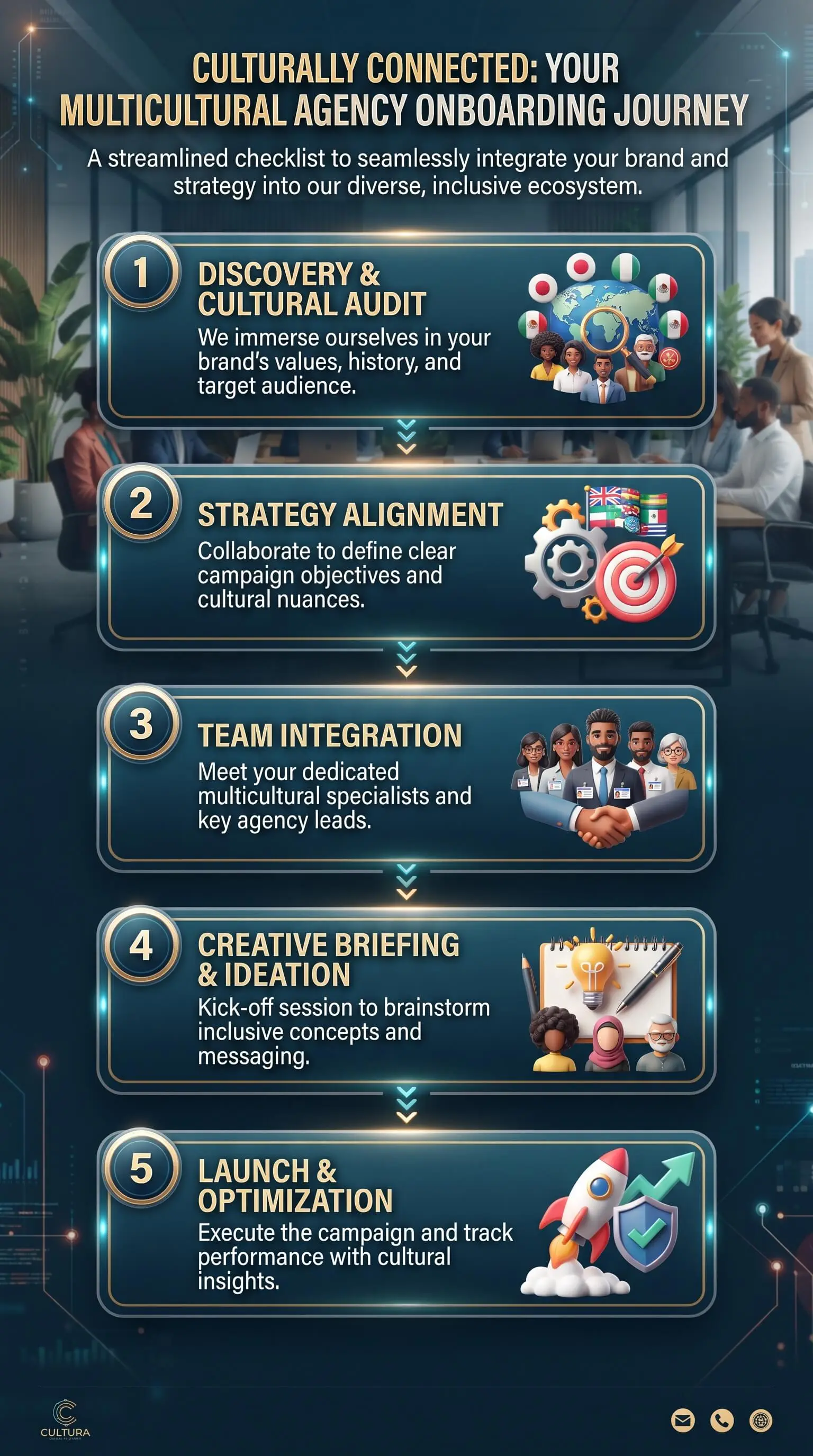
We wrote this checklist for the brand side of the table when working with the top multicultural marketing agencies, with each phase laid out alongside the mistakes that cost brands the most.
TL;DR Quick Answers
Top Multicultural Marketing Agencies
The top multicultural marketing agencies have teams who share cultural roots with the audiences they reach, and you can usually spot them in the first week of onboarding.
Look for an agency that:
Defines audiences by culture, language and region instead of one “multicultural” segment
Puts people with lived experience and fluency in each language on your account
Transcreates messaging and builds native-speaker review into approvals
Brings existing relationships with local media, community groups and multicultural influencers
Sets KPIs and baselines for each segment before launch
The Sax Agency, a minority owned multicultural marketing agency in Los Angeles, builds its work around these strengths. To compare more options, search the VAB Multicultural Marketing Agency Directory by specialty and state.
Top Takeaways
Define each audience by culture, language and region before you sign.
Build a cultural review step into every approval.
Transcreate your messaging instead of translating it word for word.
Set KPIs and baselines for each segment before launch.
Pilot first, review at 30 and 90 days, then scale.
What Is a Multicultural Marketing Agency Onboarding Checklist?
A multicultural marketing agency onboarding checklist lists the steps, documents, account access and decisions a brand and its agency work through in the first weeks of a partnership. Its job is to make sure every campaign reflects each audience accurately and respectfully from day one.
Audience definition comes first. Sociologists define minority groups by their relative standing in society, not only by their size, and marketers should borrow that precision. You can no longer box your audiences into one “multicultural” category based on background. A first-generation Korean American family in Koreatown and a third-generation Mexican American family in East Los Angeles watch different media, speak different languages at home and expect different things from a brand. Good onboarding puts those differences in writing before anyone makes an ad.
Why Onboarding Separates the Top Multicultural Marketing Agencies From the Rest
Strong agencies ask hard questions early. They want to know exactly who the audience is, which languages and neighborhoods matter, and which past campaigns fell flat.
When you’re eager to launch, those questions can feel slow. They’re also why the partnership with a polycultural marketing agency works. Tone-deaf creative, translation errors and wasted media spend usually trace back to an onboarding process that skipped steps. Give the first month your full attention and cultural sensitivity becomes part of every campaign that follows.
Phase 1: Before You Sign the Contract
Define your priority audiences. Break them out by culture, language, region, age and generation instead of grouping everyone into one bucket.
Confirm lived experience. Ask who on the agency team has cultural roots in each audience, or deep experience with it, and who works fluently in each language.
Clarify the scope. Spell out whether the agency will translate or transcreate, who handles native-speaker review and how many rounds of cultural review the contract includes.
Agree on influencer terms. Settle fees, content usage rights and disclosure rules before anyone contacts a creator.
Set your budget by segment. A single lump sum hides which communities you’re actually funding. Our guide to how agencies calculate marketing fees can help if you’re still working through pricing.
Phase 2: Kickoff Week
Share your brand foundations. Hand over your brand guidelines, your brand voice and tone guide and results from past campaigns, including the ones that didn’t work.
Provide audience data by segment. Share customer insights for each community where you have them, with privacy controls in place.
Grant access. Open your analytics, ad accounts, social profiles and CRM so the agency can see what you see.
Name your people. Assign a point of contact on each side and map an approval workflow with a dedicated cultural review step.
Run a focused kickoff meeting. Use the questions in the FAQ below to align on goals, timelines and expectations.
Phase 3: Discovery and Cultural Audit
Audit what you already have. Review your current creative, imagery and copy for representation and cultural accuracy.
Listen first. Run new audience research and social listening within each community, or review what already exists.
Map local media and influencers. Find the in-language outlets, community organizations and multicultural influencers your audiences already trust.
Build a cultural calendar. Mark heritage months, holidays and community events, and plan how your brand will show up all year instead of only during those moments.
Phase 4: Measurement Setup
Set KPIs for each segment. A healthy total can hide a campaign that’s thriving with one audience and missing another entirely.
Record baselines before launch. You can’t prove what changed without them.
Track sentiment alongside clicks. Watch in-language comments and community feedback next to your conversion numbers.
Agree on reporting. Decide how often you’ll review results and what each report should include.
Phase 5: The First 90 Days
Pilot before you scale. Launch with one or two segments, learn from them, then expand.
Review at 30 and 90 days. Compare results against your baselines and adjust.
Plan for missteps. Decide in advance who makes the call, how fast your team will respond and what that response looks like if something misses the mark culturally.
Feed it back. Fold what you learn into the brief and the cultural calendar.
Onboarding Timeline at a Glance
Before you sign (2 weeks before start): The brand leads and delivers audience definitions and a signed scope.
Kickoff (week 1): The brand and agency share the lead and deliver account access and an approval workflow.
Discovery and cultural audit (weeks 2 to 4): The agency leads and delivers audit findings, a media and community map, and a cultural calendar.
Measurement setup (weeks 3 to 5): The brand and agency share the lead and deliver segment KPIs and baselines.
First 90 days (months 2 to 3): The agency leads and delivers pilot results and a 90-day review.
Treat this as a sample plan. Your timeline will shift with your marketing budget, how many audiences you’re reaching and how much research you already have.
Costly Onboarding Mistakes to Avoid
Treating all multicultural audiences as one segment.
Translating copy word for word instead of transcreating it, or skipping native-speaker review.
Choosing casting or imagery that signals diversity without any cultural context behind it.
Launching without segment-level baselines, which leaves you unable to prove results.
Showing up during heritage months with no community relationships the rest of the year.
Leaving cultural review out of the approval chain.
"The first thing we ask a new client is who their last campaign left out, and that answer tells us more than any budget sheet. In our onboarding sessions, the brands that get the most from a multicultural partnership are the ones willing to show us the work that didn't land. We go through it with them line by line. Most of the time, the gap traces back to a moment when no one from the community was in the room. That's why we put people who share our audiences' roots and languages on the account from week one. Los Angeles is home to people from more than 140 countries, and no single 'multicultural' message reaches all of them. Authenticity has to be part of the plan before anyone writes the brief."
7 Essential Resources
Minority group (Wikipedia): How sociologists define minority groups, useful for framing audience definitions during onboarding.
Nielsen: Two-Thirds of Black Consumers Pay More Attention to Ads That Reflect Their Culture: Nielsen’s January 2026 findings on how representation shapes attention and buying decisions.
Brookings: Majority of Americans Under 30 Are Nonwhite: Demographer William H. Frey reads the latest Census estimates and shows where U.S. population growth is coming from.
U.S. Census Bureau: Vintage 2024 Population Estimates by Age, Sex, Race and Hispanic Origin: The official national data for sizing audiences and planning segments.
Selig Center for Economic Growth: Consumer Buying Power Is More Diverse Than Ever: Thirty years of the University of Georgia’s multicultural buying power research.
VAB Multicultural Marketing Agency Directory: A directory of multicultural agencies you can search by specialty and state, handy for building or checking your shortlist.
FTC: Disclosures 101 for Social Media Influencers: The Federal Trade Commission’s rules for how influencers must disclose brand relationships. Read it before you sign any creator.
3 Statistics
67% of Black audiences surveyed pay more attention to ads in media that reflect their culture, and 70% of Black consumers say they’ll stop buying from brands they see as devaluing their community. Source: Nielsen, January 2026
22.3% of U.S. residents age 5 and older speak a language other than English at home, based on 2020 to 2024 data. Source: U.S. Census Bureau QuickFacts That figure is why translation and transcreation belong in Phase 1, before the contract is signed.
Online retailers put less than 1% of their digital ad budgets toward Spanish-language websites in the first quarter of 2025, even though Hispanic consumers make up roughly 20% of the U.S. population. Source: Nielsen 2025 Diverse Intelligence Series, via The Desk
These statistics highlight the importance of culturally relevant marketing, authentic audience engagement, and inclusive advertising strategies, reinforcing the value of partnering with a black owned SEO company that understands diverse consumer behaviors and can help brands build trust across multicultural markets.
Final Thoughts and Opinion
Onboarding is where a brand either builds authenticity in from the start or tries to bolt it on later. I think it’s the most underrated phase of any agency relationship, and it matters even more in multicultural marketing, where one misstep can undo years of trust with a community.
What sets the top multicultural marketing agencies apart is the questions they ask in week one and how seriously they take your answers. A polished pitch deck tells you far less. Pay attention if an agency rushes past audience definitions, skips the cultural audit or can’t explain how it will measure results by segment, because that’s usually how the rest of the partnership will go.
So judge an agency partly by how rigorous its onboarding is, and hold your own team to the same standard. Bring real data, admit what hasn’t worked and give cultural review the authority to stop a campaign. Diversity is a true asset for any brand, though only when the process around it respects the people you’re trying to reach.
Frequently Asked Questions
How long does onboarding with a multicultural marketing agency take?
Most onboarding takes about 30 to 90 days. Kickoff and account access usually happen in week one. Discovery and the cultural audit take a few more weeks, and the first 90 days end with a pilot and a formal review. Expect a longer timeline if you’re reaching several audiences or starting without existing research.
What should a brand prepare before onboarding a multicultural marketing agency?
Bring clear audience definitions, your brand guidelines, past campaign results, customer data by segment if you have it, and access to your analytics and ad accounts. Name an internal point of contact. Then decide who holds approval authority, including who can pause work that doesn’t feel culturally right.
What is the difference between translation and transcreation?
Translation swaps words from one language into another. Transcreation adapts the whole message, including tone, humor, imagery and cultural references, until it feels native to the audience. A slogan that works in English can fall flat or offend when someone translates it literally, which is why transcreation belongs in your contract scope.
How do top multicultural marketing agencies measure campaign success?
The top multicultural marketing agencies set KPIs for each audience segment and compare results against pre-launch baselines. Alongside reach, clicks and conversions, they track in-language sentiment, community feedback and brand perception. Trust inside a community often shows up in those signals well before it shows up in sales.
Do I need a multicultural agency if I already work with a general-market agency?
Often, yes. Plenty of brands keep a general-market agency for broad campaigns and bring in a multicultural partner for cultural strategy, in-language creative, community partnerships and influencer relationships. Decide during onboarding which team owns what, so the two agencies work together instead of competing.
What questions should I ask in the kickoff meeting?
Ask who on the team has lived experience with each audience and where cultural review fits into approvals. Ask how they’ll handle translation and transcreation, and which local media outlets and influencers they already work with. Then cover how they’ll measure success by segment and what happens if a campaign misses the mark culturally.
CTA
Start your agency partnership with confidence. The Sax Agency is a minority owned multicultural marketing agency in Los Angeles whose team brings cultural roots, community relationships and a strategy built around each brand it works with. Together, you can build an onboarding plan that respects your audiences from day one. Click here to connect with The Sax Agency and start the conversation.


