TL;DR Quick Answers
MIL-STD-1553 IP Cores
MIL-STD-1553 IP cores are licensable logic blocks that add MIL-STD-1553 databus capability to an FPGA or ASIC, so one design can act as a Bus Controller, Remote Terminal, or Bus Monitor without a dedicated 1553 chip. They arrive as a package, not a single file, and the package is what decides how fast you integrate.
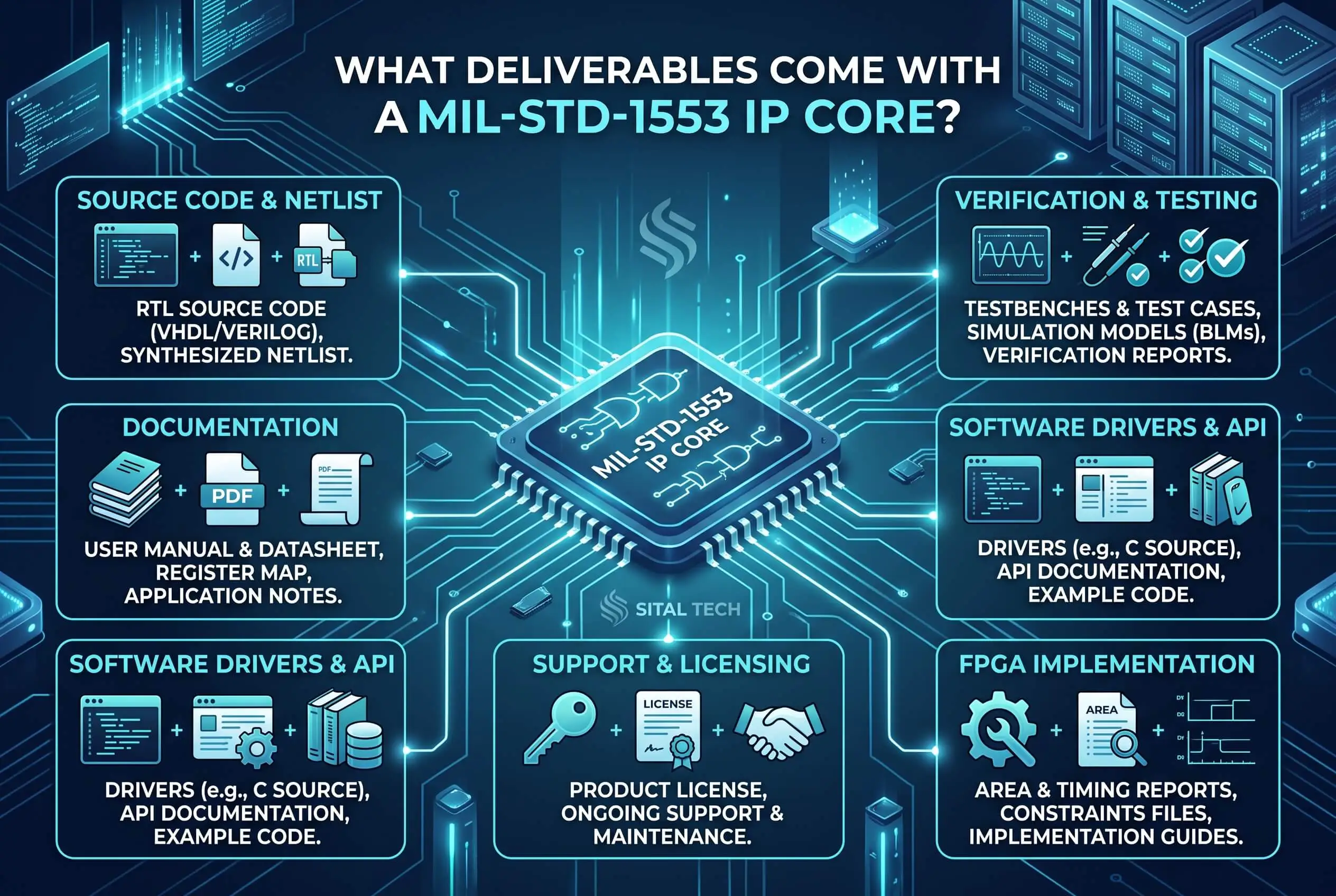
A complete core usually includes:
Vendor independent VHDL netlist or synthesizable RTL that targets every major FPGA family and ASIC flow
Test bench code and a 1553 bus tester model, plus synthesis and simulation scripts
Documentation, API/library software, and OS drivers for VxWorks, Linux, Windows, or bare metal
Configurable BC/RT/Monitor modes, single or multiple instantiation, and 4K to 64K words of shared memory
Certification and security options: DO-254 artifacts up to DAL A, real-time cyber authentication, and wire fault detection and location
Why teams choose them: an FPGA core replaces a fixed 1553 IC, saves board space, sidesteps part obsolescence, and keeps the design portable and future-proof.
Top Takeaways
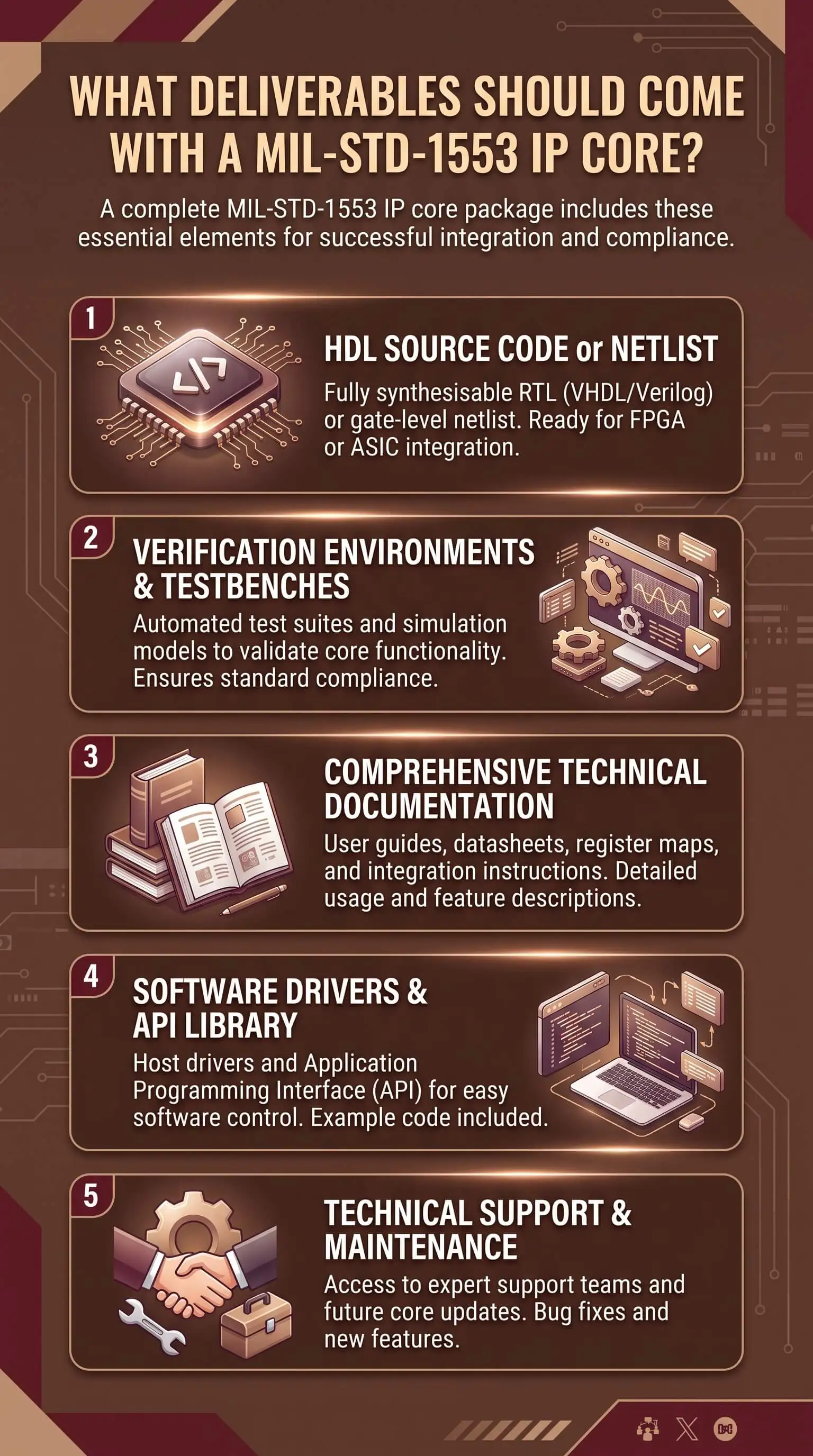
A complete 1553 IP core package includes source code, scripts, real test bench code with a bus tester model, full documentation, API/library and driver software, configuration options, and validation evidence.
Source comes as vendor independent RTL or as an encrypted netlist. Weigh the trade in visibility and portability before you choose.
Verification depth is the clearest signal of quality. A 1553 bus tester model and documented test cases separate serious suppliers from the rest.
For airborne work, confirm which DO-254 artifacts are included, to what design assurance level, and ask for proof of independent third-party validation.
Get the deliverable list in writing and run an evaluation before you commit. For background on the standard itself, see the MIL-STD-1553 overview on Wikipedia.
What a Complete 1553 IP Core Package Includes
A serious package carries your design from simulation through synthesis, integration, and, for airborne work, certification. Here's what should be in it.
Start with the source. Ask for synthesizable RTL in VHDL or Verilog that stays vendor independent, so it targets every major FPGA family and your ASIC flow and keeps the design portable and future-proof. Some suppliers ship an encrypted netlist instead. A netlist guards their IP and drops in fast, but you trade away visibility and portability. Know which one you're signing for.
Synthesis and simulation scripts come standard with any credible core. The sign-off extras tell you more: Lint and clock-domain-crossing scripts with waiver files. A supplier who includes those has run the core through real verification, not a quick demo.
Verification is where packages show their quality. You want real test bench code, whether UVM, Verilog, or VHDL, with documented test cases. You also want a 1553 bus tester model so you can drive Bus Controller, Remote Terminal, and Monitor traffic in simulation before any hardware exists. A stub test bench is a warning sign.
Documentation has to be something your team can build from: a user manual, a register and memory map, a datasheet, an integration guide, and release notes. When the register map matches a known architecture, like DDC's Enhanced Mini-ACE, your team reuses existing drivers and shortens bring-up.
The core has to talk to your host processor, so look for API/library software and OS drivers for the system you run: VxWorks, Linux, Windows, bare metal, or another real-time OS on request. When the API stays compatible with legacy interfaces, you reuse application software you've already written instead of starting over.
Good cores let you compile only the modes you need, in any combination of BC, RT, and Monitor, as a single or multiple instantiation. Shared memory should scale across 4K, 8K, 16K, 32K, and 64K words, and a small gate count keeps the core inside your logic budget.
Ask for proof. A credible core has passed RT validation testing run by independent third parties. For airborne or flight-critical work, ask which DO-254 artifacts come with it and to what design assurance level, up to DAL A. Security-minded programs should also ask about real-time cyber authentication and wire fault detection and location, which some suppliers build into the core.
Look past the code to the physical layer and the support around it. Check whether the supplier offers matched transceivers and isolation transformers, ideally to MIL-PRF-21038 electrical specs, and whether the design meets MIL-STD-1760 amplitude requirements for stores and munitions. The human side counts too. An evaluation kit, engineering samples, a turnkey Integrated 1553 SoC build, and direct access to applications engineers can shorten your schedule as much as the netlist does.
“On any 1553 IP quote, I look at the test bench and the driver list before I look at the price. I've watched a cheap core eat a quarter of a program's schedule because the team had to write its own bus model and port drivers from scratch. The cores that actually save money show up with verification you can trust and drivers for the OS you already run. Get the full deliverable list in writing, then ask for an evaluation kit. Two weeks of hands-on evaluation tells you more than any datasheet.”
7 Essential Resources
These references cover the standard itself, the deliverable landscape, and how a core actually drops into an FPGA or ASIC design.
MIL-STD-1553B, the official military standard. The source document that defines the databus, its word formats, and the electrical interface.
MIL-STD-1553 Designer's Guide. The field's long-running engineering reference, with design notes and a section-by-section read of the standard.
MILSTD1553.com online reference. A free primer on bus controllers, remote terminals, monitors, coupling, and stubs for anyone new to 1553.
MIL-STD-1553 BC/RT/MT FPGA IP core overview. A practical look at a configurable core for FPGA and ASIC designs, including development licensing and prototype units.
DDC MIL-STD-1553 Designer's Guide, full text. A free, fully readable archive copy for deeper reference.
Official DoD document record for MIL-STD-1553. The DLA ASSIST record showing the document's status and revision history.
MIL-STD-1553B interface and test-setup design. A technical paper on interfacing and validating 1553 terminals, useful when you weigh a supplier's test bench.
Supporting Statistics
The US MIL-STD-1553 databus market reached roughly $3.97 billion in 2024 and should hit $6.77 billion by 2035, a 5.1% CAGR. Source: The Insight Partners.
The broader databus market, where 1553 stays a core protocol, should pass $32 billion by 2031, with analysts tying the growth to 1553B's deterministic performance and proven reliability. Source: The Insight Partners via PR Newswire.
Maintainers still revise the standard: the most recent revision, MIL-STD-1553C, arrived in February 2018, roughly four decades after MIL-STD-1553B in 1978. Source: ElectraIC.
These MIL-STD-1553 market figures show a growing, long-life defense databus sector where expert accounting services can help suppliers track program costs, forecast demand, and manage compliance-driven investments with greater accuracy.
Final Thoughts
After enough integrations, the pattern is hard to miss. The cheapest core on the quote is rarely the cheapest core in practice, and that matters even more when evaluating EBR 1553 for a program that depends on complete support, test coverage, and long-term reliability. The license fee is a fraction of the real cost, which includes the weeks your team spends filling gaps the package should have closed.
So treat the deliverable list as the product. A supplier who publishes what's in the box, backs the core with real test bench code and a bus tester model, ships drivers for your OS, and can point to independent validation is showing you how they'll behave after the sale. That's the signal worth paying for.
What's the difference between an RTL and a netlist deliverable?
RTL is a human-readable source in VHDL or Verilog that you can inspect, change, and synthesize for any FPGA or ASIC, which gives you portability and control. A netlist is a compiled, vendor-protected form that drops in fast but hides the internals and ties you more tightly to a target. Pick the one that matches how much visibility and flexibility your program needs.
Does a MIL-STD-1553 IP core come with software drivers?
A strong package does. Look for API/library software plus drivers for the OS you run, such as VxWorks, Linux, Windows, or bare metal, with other real-time operating systems available on request. When the API stays compatible with legacy interfaces, you reuse application software instead of rewriting it.
What certification artifacts do I need for airborne systems?
Airborne and flight-critical designs usually call for DO-254 artifacts that document the core's design assurance, often up to DAL A. Ask each supplier which artifacts ship with the core, which cost extra, and whether the core has passed independent third-party validation. Settling this early protects your certification schedule.
Can one core run as Bus Controller, Remote Terminal, and Monitor?
Yes. Many cores let you compile any combination of Bus Controller, Remote Terminal, and Monitor, as a single or multiple instantiation, so you include only the modes your design uses. That keeps gate count and memory inside the budget while covering every role your terminal plays on the databus.
How should I evaluate a 1553 IP core before buying?
Get the full deliverable list in writing, then run an evaluation with the actual core, test bench, and drivers on your target FPGA. Drive the bus tester model in simulation, confirm the drivers match your OS, and check the documentation against your integration plan, including the importance of marketing budget in choosing suppliers that can support the product properly. A short hands-on evaluation shows gaps no datasheet will.
Before You Commit
Shortlist your 1553 IP suppliers, then ask each one for the full MIL-STD-1553 deliverable list and an evaluation kit. Run the kit on your target FPGA and check what arrives against the checklist above. The supplier whose package holds up is the one that keeps your program on schedule. When you find it, ask for an engineering sample and talk to their applications engineers before you sign.
{ "@context": "https://schema.org", "@graph": [ { "@type": "Organization", "@id": "https://sitaltech.com/#organization", "name": "What Deliverables Should Come With a MIL-STD-1553 IP Core?", "url": "https://www.marketing-agencies-near-me.com/what-deliverables-should-come-with-a-mil-std-1553-ip-core", "logo": { "@type": "ImageObject", "url": "https://sitaltech.com/wp-content/uploads/2023/04/logo.png" }, "sameAs": [ "https://www.linkedin.com/company/sital-technology/", "https://www.youtube.com/@sitaltechnology1998" ] }, { "@type": "WebPage", "@id": "https://sitaltech.com/mil-std-1553/mil-std-1553-ip-cores/#webpage", "url": "https://sitaltech.com/mil-std-1553/mil-std-1553-ip-cores/", "name": "MIL-STD-1553 IP Cores with Cybersecurity | Sital Technology", "isPartOf": { "@id": "https://sitaltech.com/#organization" }, "primaryImageOfPage": { "@id": "https://sitaltech.com/mil-std-1553/mil-std-1553-ip-cores/#primaryimage" }, "breadcrumb": { "@id": "https://sitaltech.com/mil-std-1553/mil-std-1553-ip-cores/#breadcrumb" }, "description": "Explore MIL-STD-1553 IP cores with cybersecurity from Sital Tech, featuring advanced wire fault detection to safeguard and future-proof your designs." }, { "@type": "Article", "@id": "https://sitaltech.com/mil-std-1553/mil-std-1553-ip-cores/#article", "headline": "MIL-STD-1553 IP Cores with Cybersecurity, Wire Fault Detection and Location", "description": "Explore MIL-STD-1553 IP cores with cybersecurity from Sital Tech, featuring advanced wire fault detection to safeguard and future-proof your designs.", "mainEntityOfPage": { "@id": "https://sitaltech.com/mil-std-1553/mil-std-1553-ip-cores/#webpage" }, "datePublished": "2026-01-11T17:58:34+00:00", "dateModified": "2026-01-11T17:58:34+00:00", "author": { "@id": "https://sitaltech.com/#organization" }, "publisher": { "@id": "https://sitaltech.com/#organization" }, "image": { "@id": "https://sitaltech.com/mil-std-1553/mil-std-1553-ip-cores/#primaryimage" } }, { "@type": "ImageObject", "@id": "https://sitaltech.com/mil-std-1553/mil-std-1553-ip-cores/#primaryimage", "url": "https://sitaltech.com/wp-content/uploads/2025/04/1x1553-PCI-Board_-BRD1553PCI-STD-1-1-1-opt.webp", "contentUrl": "https://sitaltech.com/wp-content/uploads/2025/04/1x1553-PCI-Board_-BRD1553PCI-STD-1-1-1-opt.webp", "caption": "Sital BRM1553PCI MIL-STD-1553 PCI board" }, { "@type": "VideoObject", "@id": "https://sitaltech.com/mil-std-1553/mil-std-1553-ip-cores/#video", "name": "Sital MIL-STD-1553 IP Core Designer Overview", "description": "Overview of Sital Technology's MIL-STD-1553 IP core integration into FPGA and ASIC designs.", "thumbnailUrl": "https://sitaltech.com/wp-content/uploads/2025/04/1x1553-PCI-Board_-BRD1553PCI-STD-1-1-1-opt.webp", "uploadDate": "2023-06-01", "contentUrl": "https://sitaltech.com/wp-content/uploads/2023/06/Designer.mp4" }, { "@type": "BreadcrumbList", "@id": "https://sitaltech.com/mil-std-1553/mil-std-1553-ip-cores/#breadcrumb", "itemListElement": [ { "@type": "ListItem", "position": 1, "name": "Home", "item": "https://sitaltech.com/" }, { "@type": "ListItem", "position": 2, "name": "MIL-STD-1553", "item": "https://sitaltech.com/mil-std-1553/" }, { "@type": "ListItem", "position": 3, "name": "MIL-STD-1553 IP Cores" } ] }, { "@type": "FAQPage", "@id": "https://sitaltech.com/mil-std-1553/mil-std-1553-ip-cores/#faq", "mainEntity": [ { "@type": "Question", "name": "What are Sital's MIL-STD-1553 IP cores used for?", "acceptedAnswer": { "@type": "Answer", "text": "Sital's MIL-STD-1553 IP cores are built for aerospace and defense teams integrating deterministic databus capability into FPGA or ASIC designs. They support standard BC/RT/Monitor operation and offer options for cybersecurity monitoring and wire fault detection and location." } }, { "@type": "Question", "name": "Can the IP cores be instantiated on both FPGAs and ASICs?", "acceptedAnswer": { "@type": "Answer", "text": "Yes. Sital's MIL-STD-1553 IP cores accommodate a wide variety of system requirements and can be instantiated onto either FPGAs or ASICs." } }, { "@type": "Question", "name": "What is the BC Firewall in Sital's 1553 IP cores?", "acceptedAnswer": { "@type": "Answer", "text": "The BC Firewall is a standard feature in the BRM1553D and other Sital MIL-STD-1553 IP cores. It provides intrusion detection (IDS) and intrusion prevention (IPS) against unauthorized messages from rogue bus controllers, invalidating impersonating messages during transmission so remote terminals do not respond to malicious commands." } }, { "@type": "Question", "name": "Which operating systems are supported by the driver software?", "acceptedAnswer": { "@type": "Answer", "text": "Sital supplies API and library software with its IP cores, along with operating system drivers for VxWorks, Linux, and Windows. Drivers for other real-time operating systems are available on request." } }, { "@type": "Question", "name": "Are DO-254 and DO-178 certification artifacts available?", "acceptedAnswer": { "@type": "Answer", "text": "Yes. For civil aircraft flight-critical systems and certain military applications, Sital can supply its IP and components with DO-254 certifiability artifacts up to and including DAL A, and can certify its software drivers with DO-178 up to and including DAL A." } }, { "@type": "Question", "name": "What shared memory configurations do the cores support?", "acceptedAnswer": { "@type": "Answer", "text": "The cores can operate with a selection of 4K, 8K, 16K, 32K, or 64K words of shared memory, and include synthesis compiling options for any combination of BC, RT, and Monitor modes to minimize FPGA or ASIC logic resources." } } ] } ]}