Choosing the wrong multicultural PR agency doesn't just waste your budget — it breaks the community trust you've spent years building. In a landscape where cultural authenticity is non-negotiable, knowing how to evaluate the top multicultural marketing agencies is one of the most critical decisions a brand can make.
Based on our experience analyzing agency relationships across diverse communities throughout the country, the agencies that deliver real results share a common set of signals — and the ones that fail share an equally predictable set of warning signs. Most brands find this out the hard way. This guide is designed so you don't have to.
What is marketing in a multicultural context? It's the intentional, culturally fluent act of building authentic relationships between a brand and the diverse communities that make up an increasingly majority-multicultural America. That requires more than a diverse stock photo library and a translated press release. It requires an agency with lived experience, community roots, and the credibility to earn — not just claim — trust.
We've watched brands pour six-figure budgets into multicultural PR campaigns that offended the exact communities they were trying to reach. And we've seen scrappy, mission-aligned agencies with genuine community ties produce results that money alone couldn't buy. The difference, every single time, comes down to one thing: authenticity. This guide gives you the framework to tell the difference before you sign a contract.
TL;DR Quick Answers
What Are the Top Multicultural Marketing Agencies?
Top multicultural marketing agencies are firms with authentic cultural roots, verified diverse influencer networks, and a track record of measurable ROI across specific ethnic and demographic audiences — not generalist shops that treat multicultural as an add-on service.
The strongest agencies typically offer:
Cultural authenticity — teams with direct community ties, not approximated cultural awareness
Diverse influencer networks — vetted for genuine engagement, not inflated follower counts
Bilingual/multilingual capabilities — creative and account management that works across languages
Proven campaign results — case studies with real metrics, not directional outcomes
Minority ownership or alignment — structure that reflects the communities they serve
Before hiring, ask any agency on your shortlist to demonstrate specific campaign ROI, explain their cultural vetting process, and name the communities they have direct influence in. Agencies that can't answer those questions concretely aren't top-tier — regardless of how they market themselves.
Top Takeaways
If you read nothing else in this guide, take these with you:
A multicultural PR agency is not the same as an agency with diverse clients. Demand team diversity at the leadership and strategy level — not just in creative.
Ask for community-specific case studies with named communities and measurable outcomes. Vague 'multicultural experience' is not a qualification.
The best agencies have community relationships that predate your RFP. If they're building those relationships on your dime, you're funding their education.
Cultural fluency goes deeper than language. The difference between speaking to a culture and speaking within it is detectable in every piece of copy, every campaign image, and every media placement.
Crisis communication experience in multicultural markets is non-negotiable. Ask for a specific story. The answer will reveal more than any credential.
Multicultural media investment at 5% of total budgets for a consumer base representing 40% of the U.S. population is a structural failure. The brands that correct this gap before their competitors do will own those markets.
Working with a minority-owned multicultural advertising agency creates alignment that no general market agency can replicate — because the investment flows back into the community you're trying to earn.
What Is a Multicultural PR Agency — And Why Does It Matter?
A multicultural PR agency is a public relations firm that specializes in reaching, engaging, and building trust with culturally diverse audiences — including Black, Hispanic, Asian, LGBTQ+, and other underrepresented communities — through culturally fluent messaging, authentic storytelling, and community-rooted media relationships.
That definition sounds simple. Executing it is not. General PR agencies operate on relationships with mainstream media and broad demographic assumptions. Multicultural PR demands something different: an intimate understanding of how specific communities receive and evaluate brand messaging, who they trust to deliver it, and what they recognize immediately as performative versus genuine.
The stakes are growing. The U.S. Census Bureau projects the country will become majority multicultural by 2045. Multicultural consumers already represent nearly 40% of the total U.S. population — yet multicultural media spending accounts for only about 5% of total advertising and marketing budgets. That gap is both a market failure and your competitive opportunity. Brands that close it with authentic brand strategy development and PR strategy win loyal communities. Brands that exploit it with surface-level diversity efforts get called out — publicly, loudly, and permanently.
The Real Cost of Choosing the Wrong Agency
Most brands that make a bad multicultural PR hire don't realize it until the damage is done. By then, they're not just managing a PR problem — they're managing a community trust crisis.
Here's what happens when the wrong agency is in the room:
A campaign launches with imagery that a cultural insider would have flagged immediately — and the brand spends the next six months in crisis management instead of community building.
Press releases get placed in mainstream outlets that the target community doesn't read, trust, or engage with. Impressions look fine in the report. Cultural impact is zero.
Agency leadership admits, when pushed, that they've never actually worked within the community they're claiming to reach — they've only marketed to it.
The community finds out. And they remember.
In our experience working with brands navigating multicultural markets, the fastest way to lose community trust is to let an agency create your top multicultural digital marketing ads without truly reflecting those communities. The second fastest way is to stay silent and do nothing. Both mistakes are avoidable if you know what to look for in top multicultural digital marketing ads.
7 Key Signals of Top Multicultural Marketing Agencies
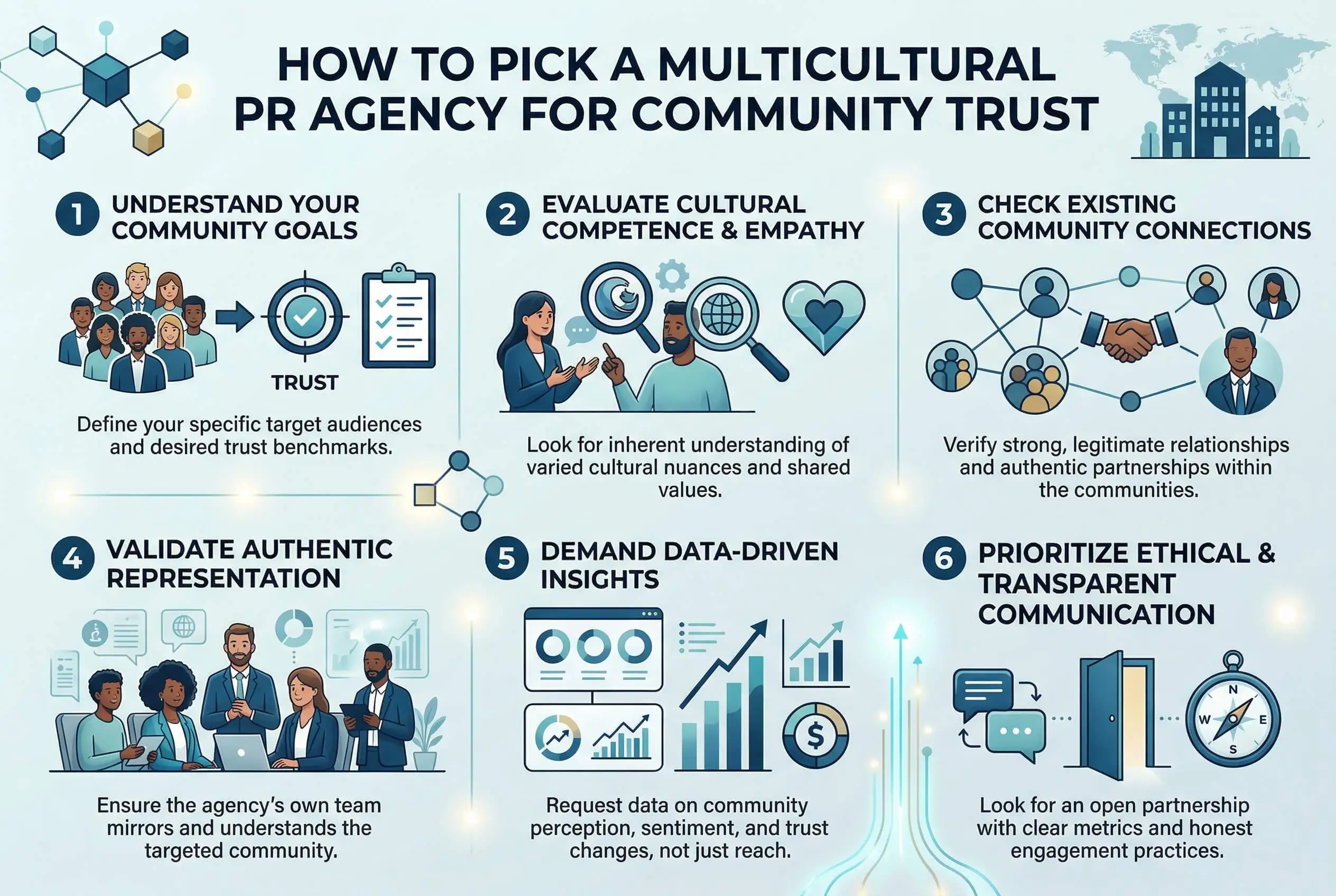
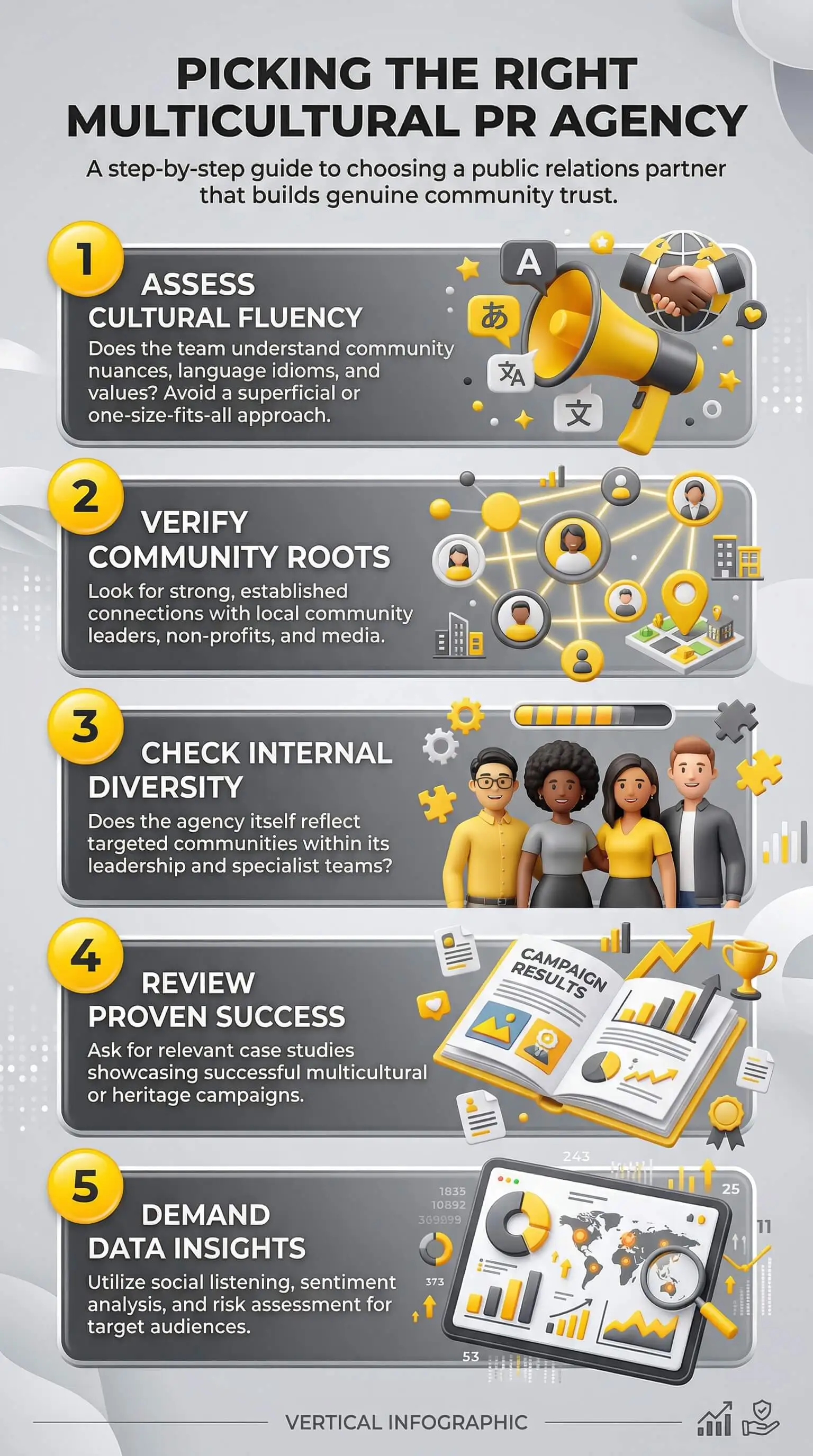
Use this framework as your evaluation checklist before you sign any contract. These are the signals that separate agencies with genuine multicultural PR capability from those performing it.
Signal 1: Genuine Cultural Representation on Their Team
Not in their client portfolio — on their team. In leadership. In creative. In strategy. Ask directly: what percentage of your senior team identifies as a member of the communities you're helping us reach? The answer will tell you everything.
An agency that markets to Black consumers without Black strategists at the table is guessing, while a black owned SEO company brings lived understanding to the work. An agency with Hispanic community members leading Hispanic campaigns is translating. These are not the same thing, and communities know the difference immediately.
Signal 2: A Portfolio of Community-Specific Results
The top multicultural marketing agencies demonstrate measurable outcomes within specific communities — not broad 'diverse audiences' or vague 'multicultural markets.' Ask for case studies tied to a named community: Black consumers in Atlanta, Hispanic families in Los Angeles, AAPI professionals in Seattle. Then ask for the numbers.
If an agency's multicultural portfolio is all imagery and no data, that's a red flag. Results in culturally specific communities are quantifiable. Authentic agencies can prove it.
Signal 3: Authentic Community Relationships — Not Just Ad Buys
The best agencies have established relationships with community leaders, culturally specific media outlets, church networks, cultural organizations, and trusted local influencers. These relationships were built before your campaign brief arrived. They exist because the agency is genuinely embedded in those communities — not because they purchased a media list.
Ask your prospective agency to name three community organizations they work with in your target market. If they can't answer without hesitation, they don't have the relationships. They have ambition.
Signal 4: Fluency in Cultural Nuance and Language
Language fluency goes far beyond translation. An agency that truly understands a community knows the difference between speaking to a culture and speaking within it. They know which phrases carry weight, which imagery carries history, and which gestures of goodwill will be received as patronizing.
Ask to see multilingual creative that was developed by native speakers — not translated after an English-language brief was approved. The edit history of a campaign brief reveals more about an agency's cultural fluency than its awards shelf.
Signal 5: Crisis Communication Experience in Diverse Markets
Cultural missteps are not hypothetical. Every brand operating at scale will eventually face a moment where something lands wrong in a specific community. The question is whether your agency has navigated that before — and whether they have the credibility within that community to help you recover.
Ask directly: tell me about a cultural PR crisis you managed for a client. What happened? What did you do? How did the community respond? An agency with real experience in multicultural crisis communication will answer this question with specifics. An agency without it will pivot to theoretical frameworks.
Signal 6: Transparent Metrics and Cultural Engagement Reporting
Authentic engagement in multicultural communities is measurable. Agencies that can't quantify community trust-building — sentiment shifts, earned media reach in culturally specific outlets, community event attendance, organic advocacy rates — are operating on assumptions, not strategy.
Before signing, request a sample reporting dashboard. Look for metrics that go beyond impressions and reach. Are they tracking engagement in culturally specific contexts? Are they measuring sentiment shifts within the target community over time? These are the metrics that prove an agency is doing the work — not just claiming it.
Signal 7: Alignment with Minority-Owned and Community-Rooted Values
Partner with agencies whose ownership and mission reflect the communities they serve. Working with a minority-owned multicultural advertising agency means your marketing investment directly supports the ecosystems you're trying to reach — creating authentic alignment from the inside out, not the marketing department outward.
This alignment matters to communities in ways that go beyond messaging. When a Black-owned agency represents your brand in the Black community, the relationship carries a different weight. When a Hispanic-founded firm tells your story to Hispanic audiences, credibility is built in. For brands serious about community trust, firms like the top multicultural marketing agencies represent the standard worth measuring against — minority-owned, community-rooted, and built with the lived expertise that no agency pitch deck can manufacture.
"Every brand eventually faces a cultural misstep. What matters isn't whether it happens — it's whether your agency has the standing in that community to help you recover. I've seen brands navigate genuine crises with minimal long-term damage because their agency had existing relationships with community leaders who trusted them enough to facilitate a real conversation. And I've seen other brands spend years trying to rebuild trust that a culturally embedded agency could have protected in the first few days. Your agency's crisis experience in multicultural markets is not a nice-to-have. It's a risk management decision."
7 Essential Resources
These verified resources will deepen your understanding of multicultural marketing strategy, consumer behavior, and agency evaluation.
SmartBrief: Multicultural Marketing in an Era of Increased Diversity — A broad look at multicultural buying power, demographic shifts, and what brands must do to engage authentically with diverse audiences.
Refuel Agency: 35+ Multicultural Marketing Statistics You Should Know — Community-specific data on Hispanic, Black, and Asian American consumer behavior, media preferences, and brand trust signals.
KORTX: Multicultural & Diversity Marketing 2024 Trends — Analysis of advertising industry diversity gaps and what brands must address to build real cultural relevance in campaigns.
Refuel Agency: Examples of Brands Who Got Multicultural Marketing Right — Real-world case studies of brands that built authentic multicultural relationships — and what made their strategies work.
SmartBrief/FutureB2B: Best Practices for Multicultural Marketing — Industry expert perspectives on the three pillars of successful multicultural marketing: research, representation, and respect.
O'Dwyer's: Best Multicultural PR Firms Rankings — The industry's leading directory of PR firms specializing in multicultural markets, ranked by net fees and community expertise.
Ronn Torossian: The Rising Power of Multicultural Marketing in 2025 — Strategic analysis of multicultural PR's growing role, including McKinsey profitability data and campaign measurement frameworks.
3 Statistics
These numbers aren't marketing trivia. They are the market forces that determine whether your multicultural PR investment builds something lasting or disappears into the noise.
$45.83 Billion U.S. multicultural advertising and marketing spend surged to a record $45.83 billion in 2024 — an 8.4% annual increase driven by Hispanic, Black, and Asian American markets. Yet this still represents less than 6% of total U.S. ad and marketing spend, even though multicultural consumers make up nearly 40% of the U.S. population. The investment gap is not a budget conversation. It is a strategic crisis.
Source: PQ Media via PRWeb, 2024
$7 Trillion Hispanic, Black, and Asian American consumers collectively hold $7 trillion in multicultural household buying power — a figure that continues to grow as the U.S. approaches its demographic majority-multicultural tipping point. Brands that treat multicultural PR as optional are not making a value choice. They are making a revenue mistake.
Source: eMarketer via SmartBrief, 2024
76% of consumers are more likely to trust brands that use authentic advertising — yet 49% have stopped engaging with a brand entirely because it did not reflect their values. Multicultural PR is not a niche strategy. It is the primary mechanism by which brands earn permission to exist in communities that have been misrepresented, tokenized, or ignored for decades. The agency you hire either earns that permission — or spends it.
Source: Phu Concepts Research Summary
Final Thoughts and Opinion
Here is what I believe after years of analyzing brand-agency relationships in multicultural markets, and it is not a popular opinion in agency boardrooms:
Most agencies that claim multicultural PR capability do not have it. They have diverse imagery in their portfolio, a translated tagline in their case studies, and a commitment to diversity in their mission statement. None of that is multicultural PR. It is the aesthetic of it.
Real multicultural PR is built on community relationships that predate any client engagement. It is executed by teams with lived experience in the communities they represent. It is measured by sentiment shifts and trust signals within those communities — not just impressions across a media buy. And it is delivered by agencies whose ownership and leadership reflect the people they are asking your brand to reach.
The market data is unambiguous: multicultural consumers represent nearly $7 trillion in buying power, nearly 40% of the total U.S. population, and the single most important growth segment for virtually every consumer brand operating in this country. And yet multicultural media spending has hovered around 5% of total ad budgets for nearly a decade. That is not ignorance. It is avoidance — and communities feel it.
The brands that will win the next decade of multicultural market share are not the ones with the biggest marketing budget, but the ones that use their marketing budget to invest early in authentic community relationships, hire agencies with genuine cultural credibility, and treat multicultural PR as a long-term brand equity strategy rather than a diversity checkbox.
The agency you choose is the beginning of that investment — or the end of it.
Frequently Asked Questions
What is a multicultural PR agency?
A multicultural PR agency is a public relations firm that specializes in building authentic relationships and trust between brands and culturally diverse communities — including Black, Hispanic, Asian, LGBTQ+, and other underrepresented groups — through culturally fluent strategy, authentic storytelling, and targeted community media placement.
How do I find the top multicultural marketing agencies?
Look for agencies with diverse leadership at the senior level, community-specific case studies with measurable results, established relationships with culturally relevant media and organizations, transparent cultural engagement reporting, and a history of navigating multicultural PR challenges successfully. Minority-owned firms with lived community experience consistently outperform general market agencies in this space.
What makes multicultural PR different from general PR?
Multicultural PR requires cultural fluency, community trust, and authentic representation at every level of the agency — from creative to strategy to ownership. Unlike general PR, it cannot be outsourced to a translation team or added as a service line after the fact. It is built into the agency's identity, team composition, and community relationships from the ground up.
What questions should I ask a multicultural PR agency before hiring them?
Ask: What percentage of your team is from the communities we are targeting? Can you share a case study with specific community outcomes and metrics? Have you managed a multicultural PR crisis — and what happened? Who are your relationships with in our target community — and how were those relationships built? How do you measure community trust and cultural engagement? The answers will separate authentic agencies from those with polished presentations.
How much does a multicultural PR agency cost?
Multicultural PR agency retainers typically range from $3,000 to $15,000 per month depending on campaign scope, community reach, and agency size. Project-based pricing is available at many firms for defined campaign engagements. Minority-owned boutique agencies often offer exceptional value relative to larger general market firms claiming multicultural capability.
Should I hire a minority-owned agency for multicultural PR?
Working with a minority-owned multicultural advertising agency ensures authentic representation at the highest levels of strategy and decision-making — which translates directly into stronger community trust and more credible brand relationships. It also means your marketing investment flows back into the communities you are trying to reach, creating alignment that general market agencies cannot replicate.
What are the red flags of a bad multicultural PR agency?
Watch for agencies that use diverse stock photography without cultural expertise behind the strategy, claim multicultural experience without community-specific case studies, have no team members from the target cultural community, rely on translation as their primary multicultural tactic, and cannot describe a specific cultural PR crisis they have managed. These are not minor concerns — they are disqualifiers.
Call to Action
Community trust isn't built overnight — but it can be lost in a moment. The agency you choose is the first signal you send to every community you are trying to reach. Make it the right one.
Ready to Stop Guessing and Start Building Real Community Trust?
Community trust isn't built overnight — but it can be lost in a moment. If you're ready to partner with one of the top multicultural marketing agencies with a proven track record of authentic community engagement, start with a firm built by and for the communities it serves.