An agency can bill seven figures a year and still not know which client paid for its last hire. The work is strong and the team is booked solid. Profit keeps slipping somewhere between the timesheet and the invoice.
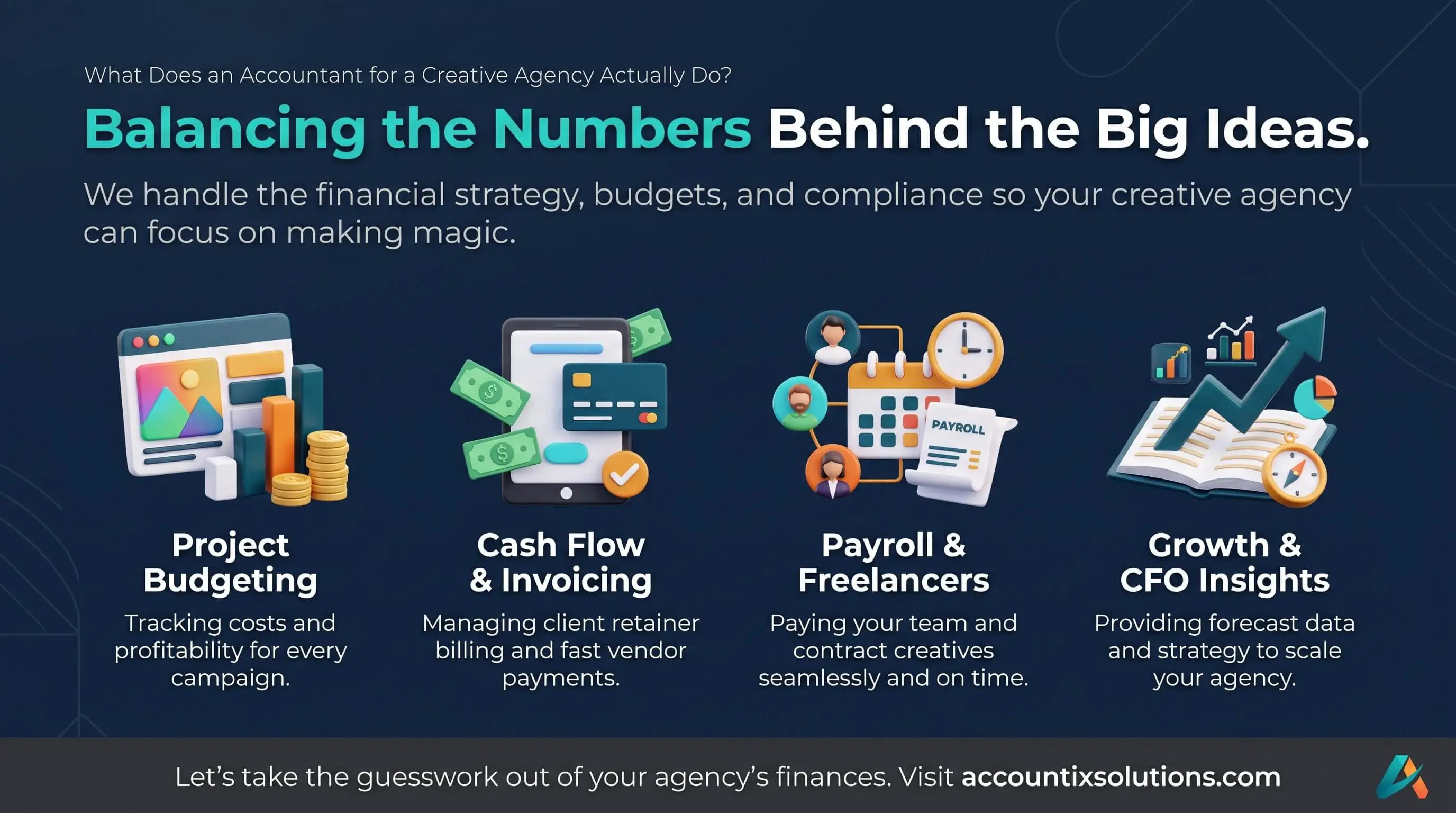
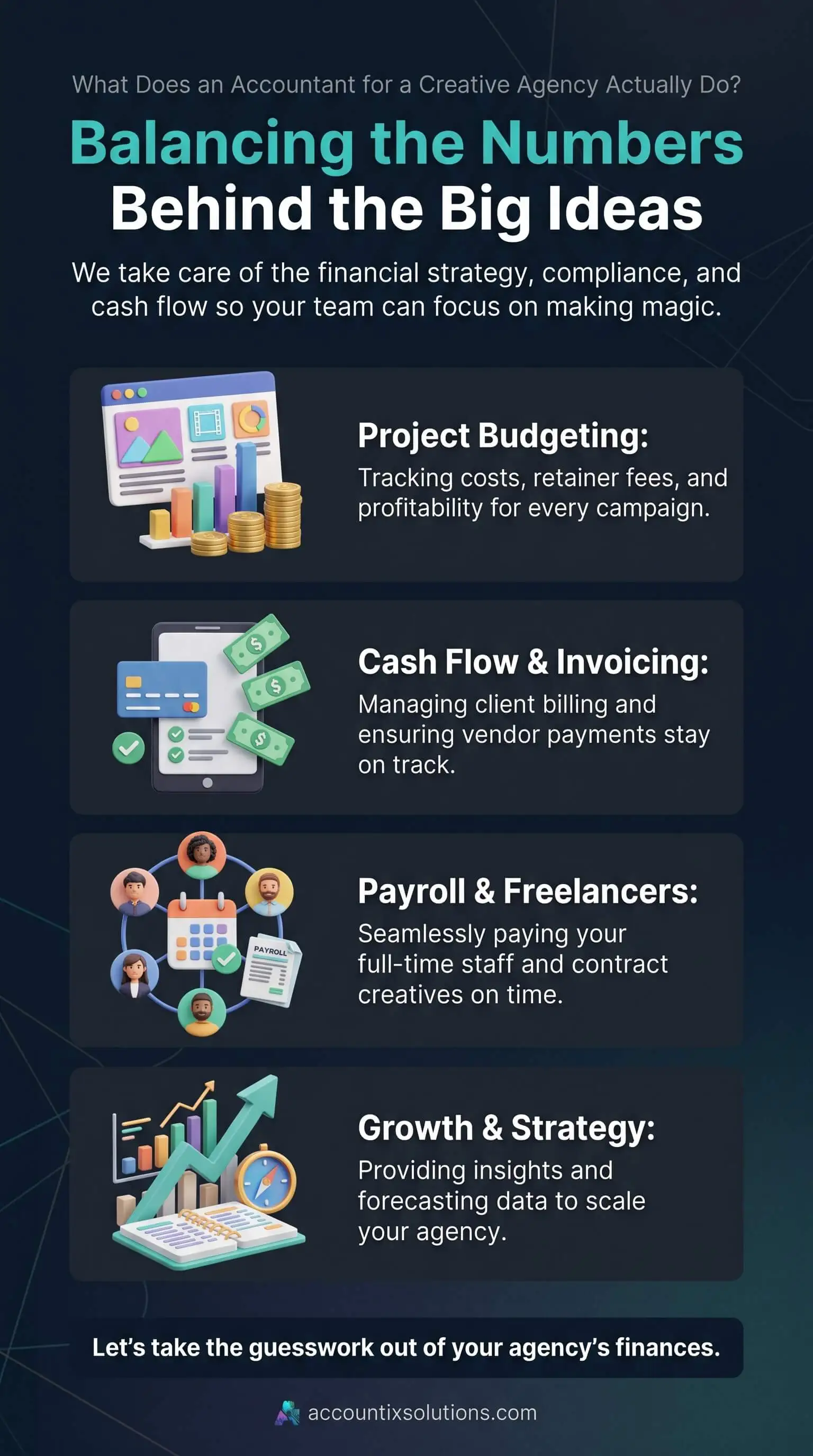
An accountant for a creative agency finds out where. They code your books by client and project, track how fast each retainer burns, handle freelancer payments and 1099s, and forecast cash against payroll so a slow month shows up six weeks early instead of on payday. That's the job accountants for creative agencies are hired to do, and it goes well past standard bookkeeping.
Standard bookkeeping tracks the basics. For an agency, profit depends on time, utilization and scope control, which is why specialized accounting for creative firms watches those first. The books at most agencies we take on are tidy enough. What's usually missing is anyone lining up hours worked against fees earned.
TL;DR Quick Answers
Accountants for Creative Agencies
Accountants for creative agencies track profit the way agencies earn it, by client, project and retainer. Where standard bookkeeping stops at what the agency spent, an agency-focused accountant shows which clients and retainers made money and which ones quietly drained margin.
What they handle:
Books coded by client, project and campaign
Retainer burn and project margin tracking to catch scope creep early
Billable utilization and unbilled work reporting
Freelancer payments, W-9s and Form 1099-NEC filing ($2,000 threshold for 2026 payments)
Cash flow forecasts that map signed work against payroll
When you need one: Once you're running several retainers or contractors and can't say with confidence which client is your most profitable.
Top Takeaways
Accountants for creative agencies show you profit by client, project and retainer, not just for the business as a whole.
Retainer burn, project margin, utilization and unbilled work are the numbers that expose scope creep early.
For payments made in 2026, Form 1099-NEC applies once a contractor is paid $2,000 or more, up from $600.
A cash flow forecast tied to pipeline and payroll gives you weeks of warning before a tight month.
Most growing agencies need bookkeeping and accounting together, with CFO support added once hiring and pricing calls get bigger.
What Accountants for Creative Agencies Actually Handle
An accountant records, reconciles and reports on a company's finances. At an agency, that work has to match how you earn money, which means billable time, retainers, fixed-fee projects and the costs you pass through to clients.
Books Coded by Client and Project
We tag every transaction to the client, project or campaign it belongs to. A $1,200 invoice from a freelance illustrator belongs to the client who asked for the illustrations, not to a general contract labor line. Our team reconciles bank and card accounts monthly and closes the books on a fixed date. Skip this step and none of the profitability reporting below holds up.
Project Margin, Retainer Burn and Utilization
Here's where agency accounting pulls away from general bookkeeping. We watch four numbers most closely:
Project margin is what's left of a project's fee after the hours and costs spent delivering it.
Retainer burn rate is the share of a retainer's budgeted hours or fees used so far this period. If a retainer is 80% burned by the 15th, a scope conversation is coming.
Utilization rate is billable hours divided by available hours. Run it too low and you're paying for idle capacity, while running it too high for long usually ends in burnout.
Unbilled work is time and cost that's been logged but not invoiced. When it piles up at month-end, your cash is sitting in a timesheet.
We compare hours and expenses against each fixed fee and retainer, usually by pulling time data from Harvest or QuickBooks Time into the books. The busiest accounts aren't always the ones paying for the agency. If you want to check the math yourself, this guide to calculating agency costs and profit is a good place to start.
Freelancers, Pass-Through Costs and 1099s
Most creative firms lean on contractors, which means chasing W-9s and filing 1099s comes with the territory. The threshold moved this year. For payments made in 2026, the IRS requires Form 1099-NEC once a contractor has been paid $2,000 or more, up from $600, with inflation adjustments after that. We keep running totals for each contractor all year, so January isn't spent rebuilding a spreadsheet.
Pass-through costs need the same discipline. Stock licenses and freelance production you rebill to a client can sit on your card for weeks if nobody invoices them, and in the meantime your working capital is funding someone else's campaign.
Cash Flow Forecasting Against Pipeline and Payroll
Agency revenue arrives in lumps, while payroll lands every other Friday. A good forecast maps signed work, billing milestones and expected collections against payroll and fixed costs. A tight month then shows up six weeks out, when you can still move up a milestone invoice or hold off on a hire. It also means someone chases overdue invoices on a schedule, not whenever a founder remembers.
Tax Planning and Coordination
Your accountant keeps the records your CPA needs, plans for quarterly estimates, and raises entity or owner-pay questions before they turn into April problems. Tax season becomes a review instead of a rebuild.
Bookkeeper vs Accountant vs Fractional CFO: Who Does What
These roles overlap, and plenty of agencies need two of them at once. The easiest way to tell them apart is which direction each one faces.
Bookkeeper. Records transactions by client and project, reconciles accounts, and processes invoices, payroll and contractor payments. It's backward-looking work, and you need it as soon as money starts moving.
Accountant. Runs the monthly close, reports on client and project profitability, tracks retainers and collections, and handles 1099s and tax coordination. Most agencies need one once they're juggling several clients, retainers or contractors.
Fractional CFO. Models cash flow, hiring and pricing, runs scenarios, and sets KPIs tied to utilization and margin. It's worth adding once a wrong call on hiring or pricing would cost you more than the CFO does.
Many agencies get bookkeeping and accounting together through an outsourced team, then bring in CFO support as they grow. If you're weighing that step, this breakdown of when a fractional CFO makes sense covers the trade-offs.
Signs Your Agency Has Outgrown DIY Books
If two or more of these sound familiar, it's probably time for agency-specific support:
You can't name your most profitable client with any confidence.
Retainers renew without anyone checking whether they made money.
Hiring decisions come down to gut feel instead of pipeline and utilization data.
Unbilled time and rebillable costs stack up at month-end.
The books close late, or only when a tax deadline forces it.
Contractor payments live in a spreadsheet, and the 1099 season is a scramble.
"When we take on a creative firm, the books are usually in decent shape. The trouble is that nobody has lined up hours against fees. We almost always find at least one retainer that's been running over budget for months, because the team kept delivering and the client was happy to keep receiving. Once an owner can see which clients are carrying the agency and which ones the agency is carrying, pricing decisions get a lot easier, and they get made before the margin is gone."
Essential Resources
1. IRS: About Form 1099-NEC, Nonemployee Compensation
The official page for the form you file for freelancers and contractors, with the current form and instructions. Check it in the fall, while there's still time to collect missing W-9s.
Source: https://www.irs.gov/forms-pubs/about-form-1099-nec
2. NATP: Form 1099 Filing Changes Under the New $2,000 Threshold
A plain explanation of what changed for 2026 payments, including the payment types that still follow different thresholds. Worth a read if your agency pays a lot of small contractor invoices.
Source: https://www.natptax.com/news-insights/blog/form-1099-filing-changes-under-the-new-2-000-threshold/
3. Federal Reserve Banks: 2026 Report on Employer Firms
Survey data from thousands of U.S. small employers on the financial challenges they actually report, from rising costs to uneven cash flow. Useful for checking whether your own cash crunches are typical.
4. U.S. Bureau of Labor Statistics: Accountants and Auditors
The government's overview of what accountants do, how they specialize and which credentials they typically hold. Handy when you're sorting out the difference between a bookkeeper, an accountant and a CPA.
Source: https://www.bls.gov/ooh/business-and-financial/accountants-and-auditors.htm
5. SBA: Manage Your Business (Manage Your Finances)
The SBA's basics on bookkeeping, cash versus accrual accounting, and the functions someone in your business has to own, from receivables to payroll.
Source: https://www.sba.gov/counseling/manage-your-business/#manage-your-finances
6. Sage: Accounting for Marketing Agencies
A practical guide to project accounting, retainer revenue recognition and the reports agency leaders should look at every month. It pairs well with the metrics above.
Source: https://www.sage.com/en-us/blog/accounting-for-marketing-agencies/
7. Deltek: 2026 PSO Benchmarks From the SPI Maturity Benchmark Report
The latest professional services benchmarks, including record-low billable utilization. Agencies sell time and expertise too, so these numbers make a fair yardstick.
Source: https://www.deltek.com/resources/articles/professional-services-benchmarks/
If you only have time for two, start with the IRS page and the Sage guide. Between them, you'll cover the compliance side and the monthly reports that tell you where agency profit comes from.
Supporting Statistics
1. Billable Utilization Hit a Record Low in 2025
SPI Research's 2026 Professional Services Maturity Benchmark found that billable utilization across professional services firms fell to 66.4% in 2025. That's the lowest in the survey's history and well short of the 75% SPI considers optimal.
Agencies bill for time and expertise too, so this is a fair benchmark for your own team.
Why it matters: Utilization only improves once someone measures it, which is why it's one of the first numbers we set up for a new agency client.
Source: Deltek: 2026 PSO Benchmarks
2. Nearly Half of Small Employers Use Contract Workers
According to the Federal Reserve Banks' 2026 Report on Employer Firms, 46% of U.S. small employer firms use contract workers.
If your agency staffs projects with freelance designers, writers or developers, you're in that group.
What it means for you: Every contractor brings a W-9, a payment schedule, possible pass-through billing and a 1099 decision. Tracked monthly, that paperwork stays routine, but left until January it can eat a week.
Source: Federal Reserve Banks: 2026 Report on Employer Firms
3. Half of Small Businesses Struggle With Uneven Cash Flow
The Federal Reserve Banks' 2025 Report on Employer Firms found that 51% of small employer firms named uneven cash flow as a financial challenge, a category that includes collecting on receivables.
Project-based revenue, upfront production costs and net-30 client terms make this familiar ground for agencies.
The takeaway: A forecast built on your pipeline and billing schedule turns a surprise into a decision you get to make in advance.
Source: Federal Reserve Banks: 2025 Report on Employer Firms
With billable utilization falling to a record low of 66.4% in 2025, 46% of small employers using contract workers, and 51% reporting uneven cash flow, creative agencies face growing financial challenges. Professional accounting services help agencies track billable hours, manage freelancer payments, and forecast cash flow to improve profitability and make better financial decisions.
Final Thoughts and Opinion
The agencies we meet rarely lack talent. What they lack is a clear view of margin, so good work gets underpriced or billed late and nobody notices until the bank balance does.
A retainer running 20% over budget barely registers in month one. By month nine, it has eaten the margin that should have paid for your next designer. In our view, that's the most common profit leak in creative firms, and it's usually fixable with a monthly review and a firmer scope clause.
So we'd treat the right accountant as part of operations rather than a compliance cost. The value shows up in the monthly conversation where you see which clients fund the agency and which ones it's quietly funding, and then decide what to do about it. Sometimes that means repricing a retainer. Sometimes it means rethinking how your agency sets its fees altogether.
Frequently Asked Questions
What does an accountant for a creative agency do?
They keep your books coded by client and project, close them every month, and report on project margins, retainer burn and utilization. They also handle contractor payments and 1099s, forecast cash against payroll, and coordinate with your CPA on taxes, so you can see where profit comes from and plan around it.
How are accountants for creative agencies different from general accountants?
A general accountant focuses on accurate records and tax compliance. An agency-focused accountant also tracks what drives agency profit: billable time, retainer burn, scope creep, unbilled work and pass-through costs. That's what lets them show you profitability by client and project instead of one number for the whole business.
Does a creative agency need a bookkeeper, an accountant or a fractional CFO?
Most agencies need a bookkeeper from the start and an accountant once they have several clients, retainers or contractors. A fractional CFO earns a place when hiring, pricing or growth decisions carry serious risk. Many agencies get bookkeeping and accounting together through an outsourced team and add CFO support later.
What financial metrics should a creative agency review every month?
Start with your profit and loss statement, client and project profitability, retainer burn, billable utilization, unbilled work, receivables aging, marketing budget and a rolling cash flow forecast. Read together, they tell you whether you're profitable, which clients are driving it, and whether cash will cover the next few payrolls.
How do agency accountants handle freelancers and 1099s in 2026?
They collect a W-9 before the first payment, keep running totals for each contractor through the year, and file Form 1099-NEC for anyone paid $2,000 or more in 2026, up from the old $600 threshold. They also make sure rebillable contractor costs get invoiced to clients promptly.
When should a creative agency outsource its accounting?
When founders are spending too much time managing cash flow, the books close late, or hiring decisions rest on instinct rather than data. If you can't say which clients or retainers make the most money, an outsourced accounting team can usually get you that answer faster than a new in-house hire.
Know Where Your Agency's Profit Comes From
Pull up last quarter's numbers and try to name the three clients that made you the most money after time and costs. If that takes more than a few minutes, or ends in a guess, it's worth a 30-minute intro call with a team that provides accounting services for small businesses and works inside creative firms every week. We'll show you where your margins are going, and there's no obligation or sales pitch attached.


