At around the $1M mark, most founders hit the same crossroads—but the real question isn’t “Should we hire a CFO?” It’s “Which financial model actually supports growth instead of slowing it down?” Based on what we’ve seen advising hundreds of early-stage companies at Accountix Solutions, the right choice isn’t about job titles—it’s about matching your financial maturity with the right level of strategic oversight. In this guide, we break down the real-world differences between fractional and full-time CFOs, including the cost traps we’ve helped clients avoid, the decision patterns we see across consistently successful small businesses, and the early warning signs that reveal when one option becomes more valuable than the other.
Quick Answers
fractional cfo
A fractional CFO provides part-time, high-level financial strategy—giving small businesses access to CFO-level insights without hiring full-time. At Accountix Solutions, we’ve seen this model deliver the clarity owners need for smarter decisions, stronger cash flow, and more confident growth—all at a cost that scales with the business.
Top Takeaways
Fractional CFOs provide affordable strategic finance support for businesses under $1M.
Their value comes from clearer, faster, data-backed decision-making.
Full-time CFOs are typically unnecessary until the business becomes more complex.
Research shows early financial clarity reduces risk and improves growth.
Fractional CFOs offer flexible, scalable expertise as the business grows.
Understanding the Core Difference
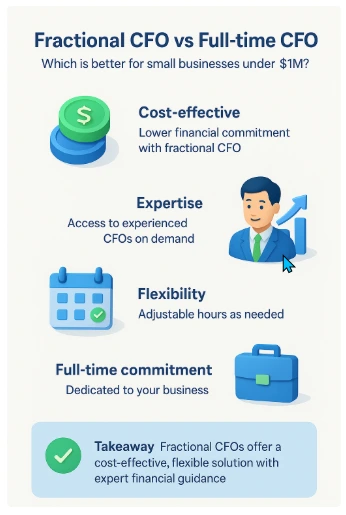
For small businesses under $1M, the real distinction between a fractional CFO and a full-time CFO comes down to cost, depth of involvement, and the level of financial complexity you actually need. A full-time CFO provides daily strategic oversight but comes with a six-figure salary most young companies can’t justify. A fractional CFO delivers the same high-level financial strategy—just in a flexible, part-time model designed for early-stage budgets, especially when supported by tailored CFO Services that scale with your business needs.
When a Fractional CFO Makes More Sense
A fractional CFO is ideal for businesses still stabilizing cash flow, building financial systems, or preparing for the next growth phase. They help with forecasting, budgeting, pricing, fundraising prep, and financial decision-making—without the overhead of a full-time executive. For most sub-$1M companies, this offers the perfect mix of expertise and affordability.
When a Full-Time CFO Becomes Necessary
As your business scales past $3–5M, handles complex operations, or engages in major financing, a full-time CFO becomes more valuable. At that stage, real-time financial management, cross-department leadership, and long-term capital strategy justify the investment—especially when supported by integrated Accounting Services that keep operations precise and audit-ready.
Which Option Is Better for a Sub-$1M Business?
For nearly all companies under $1M, a fractional CFO provides more value per dollar. You get senior-level guidance to avoid financial mistakes, improve profitability, and make data-backed decisions—without committing to an executive salary too early.
Bottom Line
If your business is under $1M, the smarter, leaner, and more strategic choice is almost always a fractional CFO. You get the expertise you need right now, with the flexibility to scale into a full-time CFO when your complexity—not just your revenue—demands it.
Essential Resources to Help You Choose the Right CFO Model
1. What a Fractional CFO Actually Does — The Strategic Support Most Small Businesses Really Need
A clear breakdown of the responsibilities fractional CFOs handle day-to-day, giving you a practical look at what meaningful financial leadership actually involves—without the full-time price tag.
Source: https://www.theexpertcfo.com/what-does-a-fractional-cfo-do/
2. Why Small Businesses Choose Fractional CFOs — Smarter Spending, Stronger Strategy
A concise overview of the advantages we most often see in the field: flexible involvement, high-impact strategic guidance, and dramatically lower overhead compared to a traditional CFO hire.
Source: https://www.accountingtoday.com/list/11-reasons-to-hire-a-fractional-cfo
3. How Fractional CFOs Help Companies Stabilize and Scale — Real Scenarios You’ll Recognize
This guide highlights situations we frequently encounter at Accountix Solutions—everything from cash flow instability to early growth stages where better financial visibility creates outsized gains.
4. The CFO on Demand Model — Built for Lean Teams That Need Strategy, Not Executive Payroll
A practical look at why on-demand CFO support works so well for early-stage companies. You get senior-level financial insight when you need it—without paying for hours you don’t.
Source: https://www.gofractional.com/blog/fractional-cfo
5. When to Bring in a Fractional CFO — The Signals We Watch for in Sub-$5M Businesses
This resource outlines the financial indicators that typically prompt our clients to seek strategic support, including increasing complexity, unclear cash flow trends, and upcoming investor or lender conversations.
6. Expert Insights From Seasoned CFO Practitioners — What Actually Moves the Needle
A behind-the-scenes look at the impact experienced fractional CFOs create—from pricing corrections to forecasting upgrades to system improvements that eliminate costly blind spots.
Source: https://digitaldefynd.com/IQ/benefits-of-hiring-a-fractional-cfo/
7. Fractional CFOs as Growth Partners — Strengthening Systems for Long-Term Stability
This piece explains how fractional CFOs help build durable financial systems that continue to support growth over time, helping businesses avoid the most common scaling pitfalls.
Source: https://volpeconsulting-accounting.com/blog/fractional-cfo/
Supporting Statistics
1) Debt is common among small employer firms
According to the 2024 Small Business Credit Survey (SBCS), 71% of small employer firms had outstanding debt in 2023.
Many small businesses carry this debt well before scaling.
Why it matters: A fractional CFO can help integrate debt-servicing into cash-flow planning — a critical move before debt becomes a burden.
Source: Office of Advocacy+1
2) Financial stress is nearly universal — uneven cash flow & rising costs are common
The 2024 SBCS shows that more than half of firms reported uneven cash flow or difficulty paying operating expenses.
Common issues include rising costs for goods, services or wages.
Why it matters: These recurring financial challenges highlight the need for expert financial oversight — precisely what a fractional CFO delivers without the cost of a full-time hire.
Source: CAMEO+1
3) Many small firms carry large debt burdens — increasing financial risk
In the 2024 survey, about 39% of firms reported more than $100,000 in outstanding debt, up from 31% in 2019.
Debt levels remain elevated compared to pre-pandemic norms.
Why it matters: Large debt loads make cash-flow management and debt servicing more complex — a level at which fractional CFO expertise becomes especially valuable.
Source: Office of Advocacy+2Experian+2
Final Thought & Opinion
We've watched the role of a fractional CFO evolve from a “nice-to-have” into one of the most strategic early hires a growing business can make. The data confirms what we’ve seen firsthand: when founders gain financial clarity early, their decision-making sharpens, their risk tolerance becomes grounded in reality, and their growth trajectory accelerates with far fewer surprises—similar to how a well-planned Marketing Budget provides structure and predictability for sustainable growth.
From our experience inside scaling companies, the real advantage isn’t just the reports or forecasts—it’s the confidence that comes from having an expert who has already navigated the same turning points dozens of times. Fractional CFOs don’t just interpret financials; they translate them into strategic moves founders can act on today.
In a landscape where margins tighten, investor demands intensify, and competition gets smarter, having fractional CFO leadership isn’t optional for long. It’s the difference between managing numbers and mastering them—much like how a Marketing Company helps businesses navigate complexity with sharper strategy and smarter execution.
Next Steps
Clarify Your Needs
Identify financial blind spots.
List decisions you need help with.
Define Support Level
Strategic help → fractional CFO.
Daily financial tasks → bookkeeping/accounting.
Check Your Financial Health
Review your reporting cadence.
Ensure data is accurate and decision-ready.
Compare Service Models
Weigh cost differences.
Consider scalability as you grow.
Review Key Resources
Revisit essential guides.
Save helpful tools and links.
Book a Discovery Call
Ask specific questions.
Evaluate fit and expectations.
Make a Data-Driven Choice
Choose the model that aligns with your stage and goals.
Prioritize partners with proven small-business experience.
FAQ on “fractional cfo”
Q: What does a fractional CFO do?
A: Handles cash flow clarity, forecasting, budgeting, and decision support.
Focuses on forward-looking strategy.
Q: When should a small business hire one?
A: Typically between $500K–$2M in revenue.
When decisions feel risky or outgrow “gut instinct.”
Q: How is this different from bookkeeping or accounting?
A: Bookkeepers record the past.
Accountants report the past.
Fractional CFOs shape the future with strategy.
Q: What does a fractional CFO cost?
A: Usually $2,000–$8,000 per month.
Lower cost than full-time CFO salaries.
Q: Can a fractional CFO help with funding prep?
A: Yes. They create financial models, dashboards, and investor-ready materials.
Improves confidence and due diligence readiness.